Purpose: The purpose of drawing up this Regulation is to make the work environment safe during the operation, maintenance, repair, development, reconstruction and optimization of power transmission lines and facilities, to prevent occupational accidents and, ultimately, to protect the country's human resources and material resources.
Scope of application: This Regulation has been drawn up pursuant to Articles 85 and 86 of the Labour Code of the Islamic Republic of Iran and is mandatory for all persons involved in carrying out the operation, repair and maintenance of power transmission equipment and facilities.
Network: A set of substations, lines, cables and other electrical equipment connected together to transmit the energy generated at power plants to the end consumer.
Transmission network: Refers to the set of equipment and facilities in operation (whether state-owned or non-state-owned), including overhead lines, underground cables and substations at various voltage levels, located within the defined physical boundary with the generation and distribution networks.
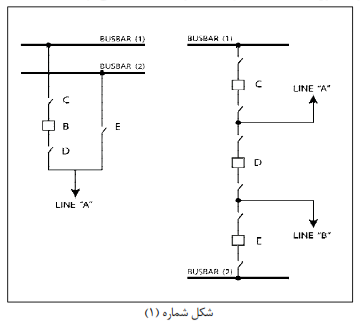
Bay: A set of equipment at a substation, which may include a breaker, disconnector, reactor, capacitor, surge arrester and the like, arranged in a specific configuration to equip part of the network circuit.
Substation (power station): A location with a set of electrical facilities and equipment, such as transformers, switches, disconnectors, measuring devices, incoming and outgoing lines, reactors, capacitors and various bays, used for the transmission and distribution of electric power.
Control center (dispatching): A center responsible for operating and monitoring the power network under its coverage; any operation on the network is carried out in coordination with this center.
Code: Refers to the dispatching number (equipment identification number), which must correspond to the station's single-line diagram (SLD).
Voltage: The electrical potential difference between two points of a circuit.
Circuits: The network's main equipment, comprising lines, transformers, reactors, capacitors and busbars.
Switching off (de-energizing): Disconnecting the electrical circuit from electrical energy sources by means of a switch or fuse, in such a way that connecting the circuit to the safe earthing network is not obstructed.
Isolation: Separating equipment, devices or lines from all energy sources.
De-energization: Discharging any type of energy from devices or lines after isolation from the energy sources has been carried out.
Switching operation: Any operation of opening and closing network equipment for switching off and energizing, or for transferring electrical load.
Operator: A person responsible for controlling the lines and operating the station placed under their charge.
Mobile operator: An operator who works at substations that do not have an operator.
Dispatching operator: A person who works at the control centers (dispatching centers).
Note: The Ministry of Energy determines the criteria and conditions for selecting operators, mobile operators and dispatching operators, and their job descriptions, taking into account the laws, regulations and by-laws approved by the Supreme Council for Technical Protection.
Requester: A qualified person who may, for themselves or for the work executor, request the operations official to issue a safety guarantee certificate (ضمانتنامه - in everyday Persian this word means "bank guarantee", but under this Regulation it denotes the work-authorisation certificate for transmission work, not a financial instrument) and protection cards; the requester must be introduced in writing by one of the managers of the relevant regional electricity company.
Work executor: The person responsible for carrying out the work, who must meet the following conditions: (a) Have successfully completed the necessary safety training from competent authorities and obtained the relevant certificate. (b) Have their technical-operational work skills approved by the relevant officials, and bear responsibility for the safety of the personnel under their supervision. (c) Be introduced by the requester of the safety guarantee certificate and personal protection card issuance as the person carrying out the work.
Deputy work executor: A person who meets the conditions of the work executor and who, in the work executor's absence or where necessary, assumes all of the work executor's responsibilities after obtaining the required authorisations.
Note: Wherever this Regulation refers to the work executor, this shall include the work executor themselves or their deputy.
Operations official: Includes the deputy, the affairs manager, the head of operations departments, the substation manager and the operator.
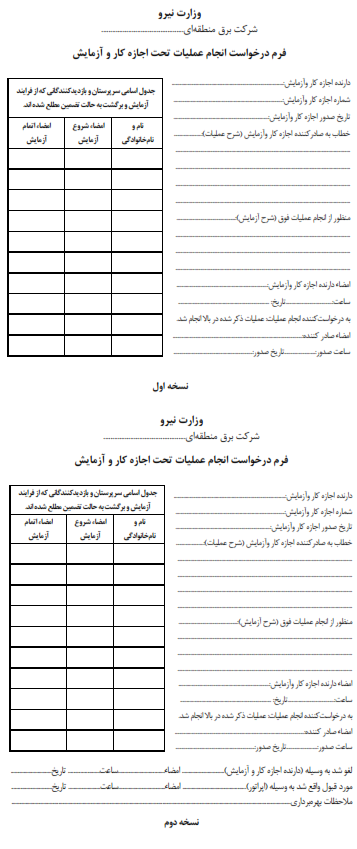
Recipient of the guarantee certificate request form: Refers to the person (operations official) who, after receiving the guarantee certificate request form, checks the accuracy of the details entered by the requester and, if taking the requested equipment or lines out of service does not create a problem, completes the rows relating to the recipient of the guarantee certificate request form.
Approver of equipment or line outage from the circuit: The head of the control (dispatching) center.
Final approver on the guarantee certificate request form: The station operator on duty or the mobile operator.
Permitted work: Fully specified work carried out on the devices, equipment and lines recorded and approved in the guarantee certificate request form. The work executor is under no circumstances permitted to carry out any work other than what is recorded on the guarantee certificate form.
Permitted device: Refers to the fully specified lines and equipment on which work has been recorded and approved on the guarantee certificate forms or protection cards.
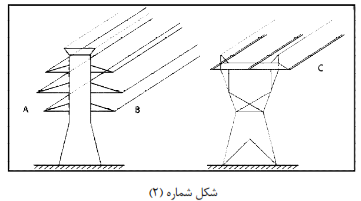
Power transmission lines: Lines that connect the circuit or circuits of related stations to one another. These lines may be single-circuit, double-circuit or multi-circuit.
Live line: A line on which no isolation or de-energization operation has been carried out for the purpose of work, and which is therefore considered energized.
Transformer: A converter installed at a substation or power station, used to increase or decrease the voltage of an electrical circuit.
Breaker (circuit breaker): Refers to the power switch, which is capable of being opened under load.
Disconnector: A switch in the transmission and distribution network that cannot be opened under load, and whose contact separation is generally visible when the circuit is opened and closed.
Earthing disconnector: A disconnector used to carry out the de-energization operation.
Earthing: An electrical connection made to equalize the potential of a line or equipment's voltage with the earth; this is called earthing.
Earthing equipment: Equipment that, after a device or line has been switched off, discharges any energy stored in the circuit to earth.
Test: A process carried out to verify the correct functioning of substation or line equipment, which causes a change in the conditions of the guarantee points (isolation and de-energization) or energizes part of the lines or devices within the work area.
Permitted test: Refers to the specific tests carried out to verify the correct condition and integrity of a device, which have been recorded and approved by the responsible authorities on the issued work and test permit form. The work executor is not permitted to carry out any tests other than those recorded on the form.
Guarantee point: Refers to the isolation and de-energization point whose contacts are visible. Where the contacts are not visible, such as at gas-insulated substations (GIS) or similar, all three phases of these disconnectors must, after the isolation operation is complete, be tested using safety tools and equipment specific to and suited to the voltage level, to confirm whether the contacts are open or closed; where possible, they shall be placed in the open or closed position and locked or disabled, such that their state cannot be changed until the issued permits are cancelled or the approved work-and-test-permit operation form has been carried out.
Fencing off the work area: Defining the boundaries of the permitted work area, in accordance with the issued work permit form, using suitable equipment and tools. The purpose of fencing off the work area is to establish the physical boundary of the work area (including devices or lines) from the energized section.
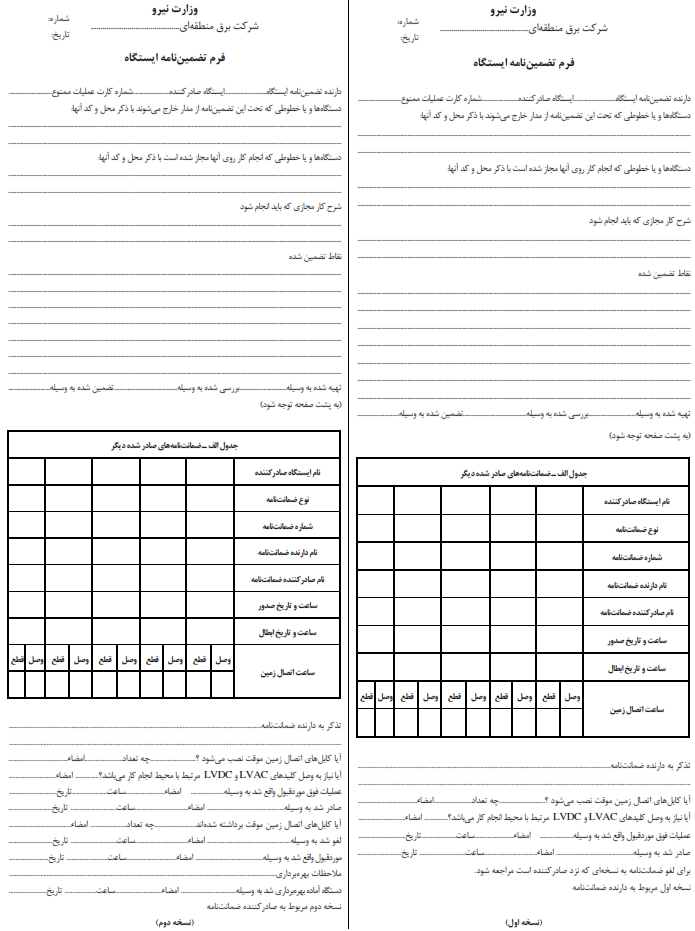
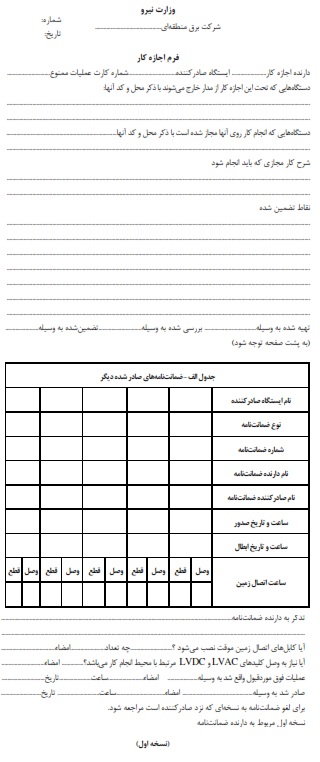
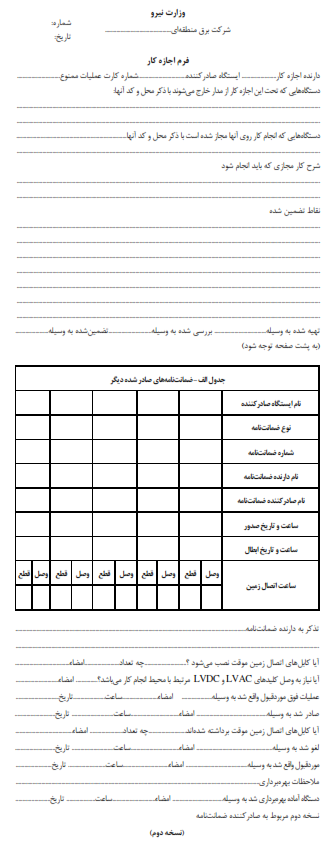
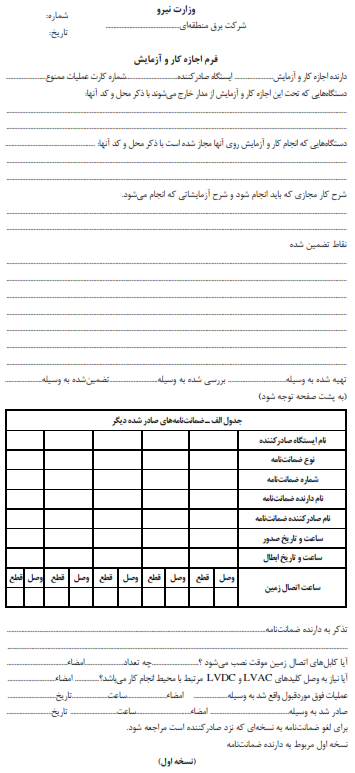
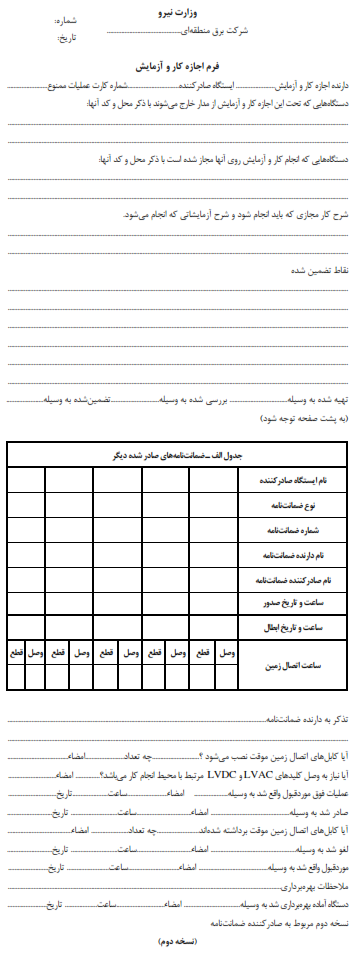
Table A: A table containing information on other issued guarantee certificates, including guarantee certificates that share guarantee points with the issued guarantee certificate and, where a guarantee certificate form needs to be obtained to protect the area from another location, its contents - comprising the name of the issuing station, the type of guarantee certificate, the guarantee certificate number, the name of the guarantee certificate holder, the name of the guarantee certificate issuer, the time and date of issue, the time and date of cancellation, together with the time the earthing was connected and disconnected - are recorded in it.
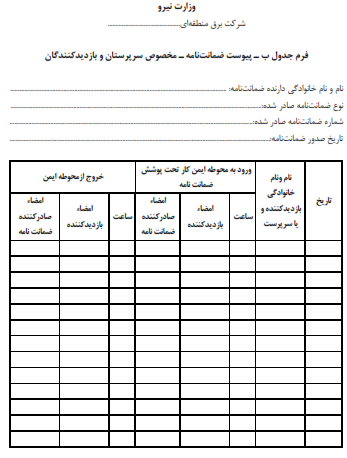
Table B: A table specifically for recording the names of visitors and supervisors, whose names are entered and signed in it. These persons do not include the personnel working under the supervision of the guarantee certificate holder.
Visitors and supervisors: Persons intending to visit or oversee the work process and work area, whose names are recorded and signed in Table B attached to the guarantee certificate. These persons do not include the personnel working under the supervision of the guarantee certificate holder.
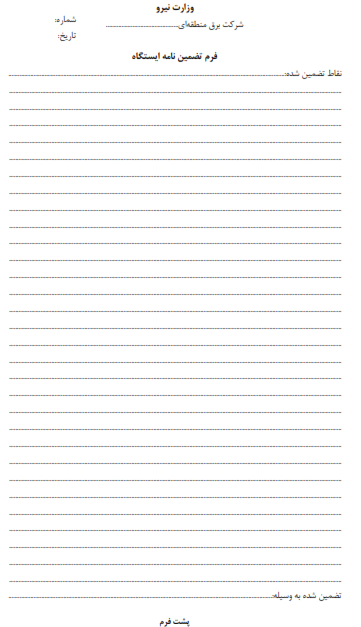
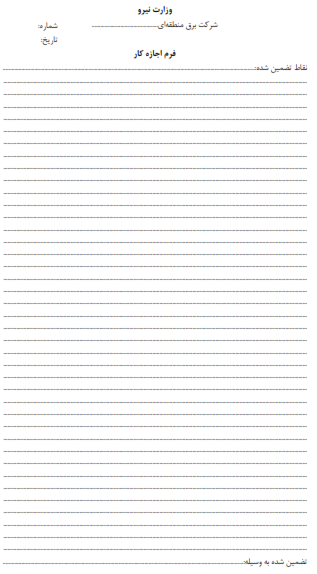
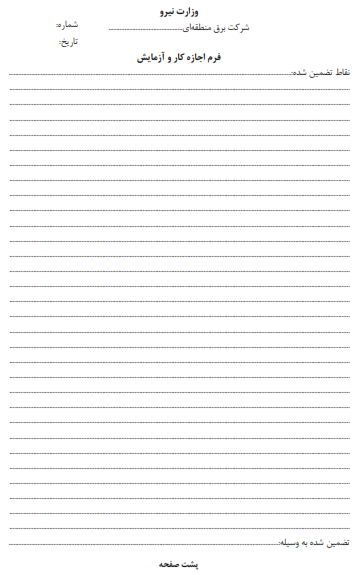
Types of guarantee certificate (protective) forms: Depending on the conditions and location of the work, various guarantee certificate forms are used, such as the work permit form, the work and test permit form, the request form for operations under the work and test permit, and the station guarantee certificate form.
Work permit form: A form that serves as authorisation to work on a circuit or devices, creates fully safe conditions for carrying out the work, and guarantees that no energy (except LVAC and LVDC requested by the work executor) will flow in the circuit. This form is issued where sufficient guarantee can be obtained for part of the circuit and there is no need to change the guarantee points for testing during the work.
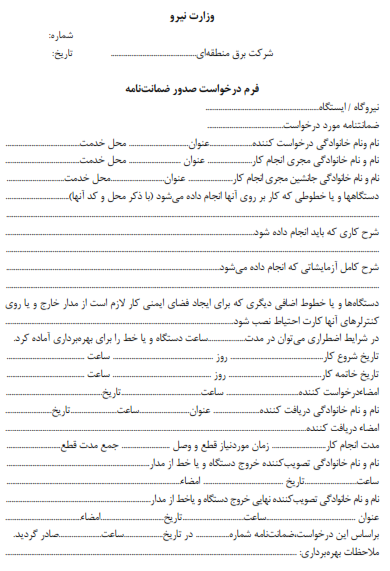
Guarantee certificate request form: A form that the requester must complete and deliver to the operations official for review and issuance of the guarantee certificate.
Guarantee certificate form: An authorisation on the basis of which the guarantee certificate holder (work executor) may carry out the permitted work from the time of issue until the guarantee certificate is cancelled.
Work and test permit form: A form that serves as authorisation to work on a circuit or devices and also to carry out permitted tests (whether electrical or mechanical), creates fully safe conditions for carrying out the work, and guarantees that no energy (except LVAC and LVDC requested by the work executor) will flow in the circuit. This form is issued in circumstances where the guaranteed conditions will change because a request form for operations under the relevant work and test permit needs to be issued.
Request form for operations under the work and test permit: A form for recording a request to carry out the required permitted operations and tests (electrical and mechanical) on a circuit or device, or to declare that the tests carried out are complete so that the circuit can revert to its original guaranteed state; it is completed by the guarantee certificate holder, and the operator proceeds to issue it.
Station guarantee certificate form: The station guarantee certificate form does not create fully safe conditions for carrying out the work, but it guarantees that no energy will flow through the issuing station or the related stations. The station guarantee certificate form is issued only in circumstances where sufficient guarantee cannot be obtained for part of the circuit; this form is equivalent to a work permit, and the provisions of the issued guarantee certificate must be fully complied with.
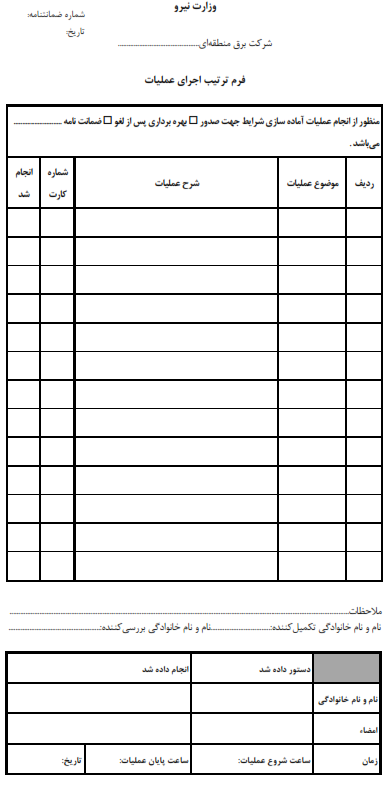
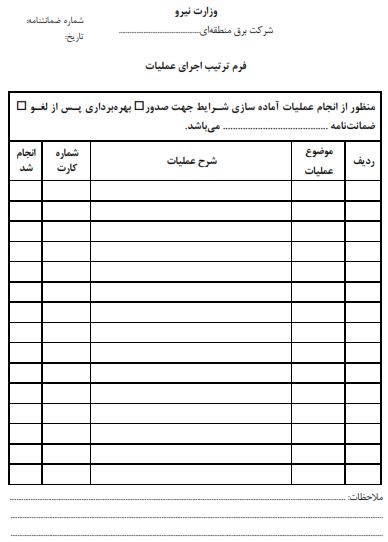
Sequence of operations form: A form for the operations to prepare conditions for issuing a guarantee certificate or for returning to service after a guarantee certificate is cancelled, including switching, isolation and, ultimately, bringing a device or line into or taking it out of the circuit, in such a way that the correct sequence for carrying out the operations is recorded in it; once its accuracy has been confirmed, it is carried out in the order recorded on the form, and it renders the work area and environment safe.
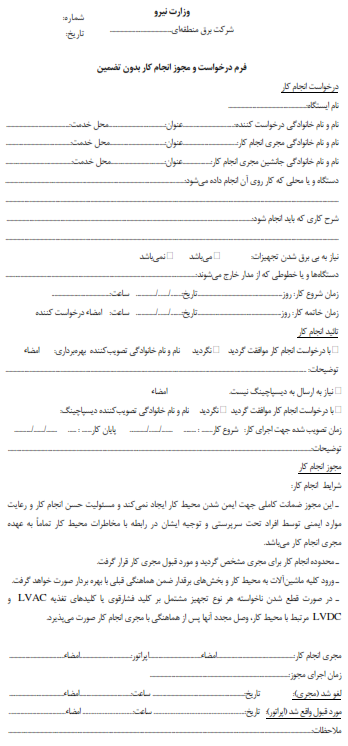
Request and permit for work without guarantee form: A form that does not create a full guarantee for keeping a circuit, device or part of them switched off, and is used in cases where a full measure to render the work area safe cannot be implemented by the issuer.
Cancelled guarantee certificate: A guarantee certificate whose cancellation, after being cancelled by the guarantee certificate holder, has also been accepted by the station operations person on duty.
Form preparer: The form preparer is the station operator or the mobile operator. (This refers to "prepared by" on the protective forms.)
Issuer of guarantee certificate forms: The station operator on duty or the mobile operator.
Reviewer of guarantee certificate forms: The station operator on duty or the mobile operator.
Guarantor of guarantee certificate forms: The station operator on duty or the mobile operator.
Completer of guarantee certificate forms: The operator on duty for the shift.
Approver of equipment or line outage from the circuit: The relevant control center (dispatching).
Final approver of equipment or line outage from the circuit: The station operator on duty or the mobile operator.
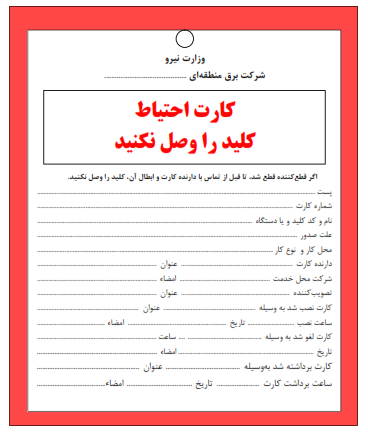
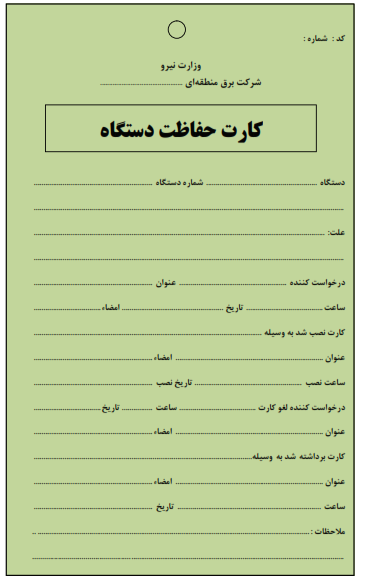
Types of protection cards: Depending on the conditions and location of the work, various protection cards, such as the caution card, the personal protection card and the device protection card, are issued at the station.
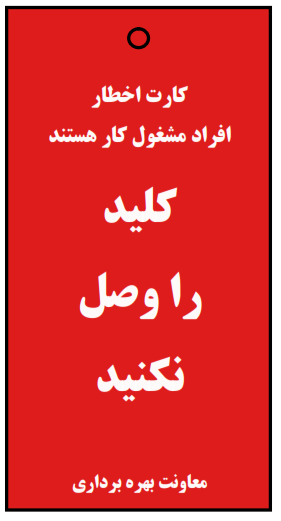
Caution card: A card that creates conditions preventing devices or lines from being re-energized once they have been switched off. Isolation and de-energization operations (electrical or mechanical) are not carried out for its issuance. Consequently, it does not guarantee any form of protection, and it must never, under any circumstances, be used as authorisation to work on lines or devices.
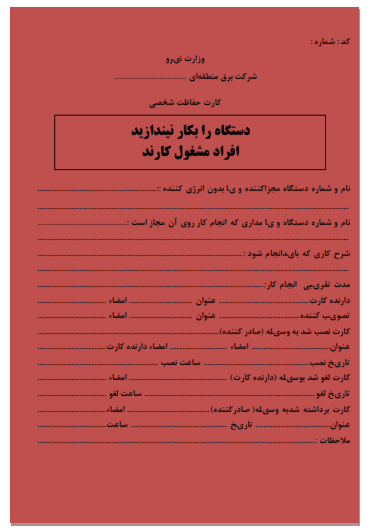
Personal protection card: A card for whose issuance the isolation and de-energization operations are carried out; as a result, the work area is made safe, and personnel from maintenance or inspection teams are permitted to work on devices, circuits and the like. This card is requested verbally and in person.
Device protection card: A card that prevents operations from being carried out in the following circumstances: (a) Protecting a device and its equipment from further damage. (b) Keeping the electrical circuit stable. (c) Preventing damage to other devices and equipment.
Warning card: A card issued to notify personnel in the work area of an abnormal condition of lines and equipment, and to prevent potential hazards from occurring.
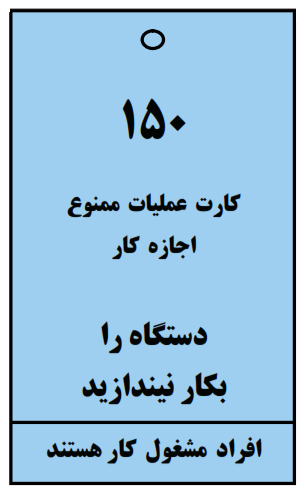
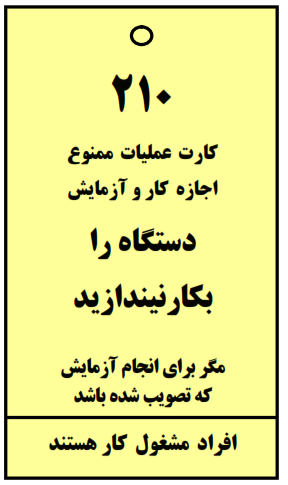
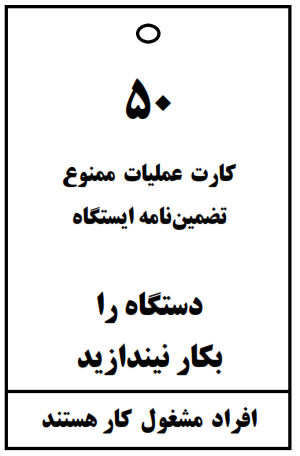
Prohibited operations card: A card that must be installed on the guarantee points during the safety-making operation, to prevent any operation from being carried out until the work is complete and the guarantee certificate is cancelled.
Chapter One - Definitions and Terminology
Chapter Two - Safety Regulations
All persons who, for any reason, attend a substation to carry out an activity shall, before taking any action, go directly to the control room and report to the operator on duty at the substation. Thereafter, only the persons authorised to coordinate the execution of the work shall remain in the control room, and the remaining persons shall leave the control room.
To create a safe work environment, the following operations shall be carried out: (a) Switching off. (b) Isolating devices, circuits and lines from energy sources. (c) De-energizing devices, circuits and lines from energy sources. (d) Installing locks, latches and other safety devices. (e) Installing prohibited operations cards and hazard notices at the required locations. (f) Fencing off the work area (marking out the permitted work area using safe equipment). (g) Issuing guarantee certificate forms. (h) Issuing and installing protection and warning cards. (i) Installing temporary earthing.
Isolation
To make the work area safe, the isolation operation shall be carried out before work begins.
Note 1 - The isolation operation comprises isolation from electrical and mechanical energy sources; electrical isolation shall be carried out before mechanical isolation.
Note 2 - Once the operation is complete, all keys for the installed safety locks, safety latches, removed fuses and other tools relating to the isolation guarantee points shall be kept together alongside the file of the issued guarantee certificate, and shall not be accessible.
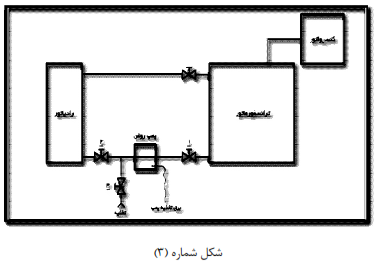
The isolation operation from electrical energy sources shall be carried out under the following conditions: (a) A disconnector shall be used. (b) Disconnectors with visible contacts shall be used, so that the open or closed state of the contacts can be determined by looking at them. (c) Where disconnectors without visible contacts are used for the isolation operation, such as at gas-insulated substations (GIS) or similar, the operator shall, after the isolation operation, confirm that the isolation operation was carried out correctly. The work executor shall then, before starting work, test all three phases of these disconnectors using safety tools and equipment specific to and suited to the voltage, to confirm whether the contacts are open or closed, so that the point can be regarded as a guarantee point. (d) All disconnectors used to carry out the isolation operation shall be placed in the open position, and their operating mechanism or shaft shall be locked to prevent them from being closed unintentionally by mechanical means. Where these disconnectors are fitted with an electric motor for opening and closing, the motor control circuit shall, in addition to the above, also be interrupted and disabled by some means, including removing the motor fuses, removing part of the control mechanism, removing the main fuse, switching off the motor supply switch, or other methods, to prevent them from being closed unintentionally by electrical means. (e) For lines terminating at GIS substations or similar, where disconnectors without visible contacts are used, the operator shall, after the isolation operation, confirm that the isolation operation was carried out correctly. (f) To carry out the isolation operation, the AC and DC supply to the equipment and control circuits shall also be switched off, and the panels containing the fuses for this equipment shall be locked. (g) Where all or part of items (d) and (f) cannot be carried out, this shall be recorded in the "Notice to the Guarantee Certificate Holder" section on the forms and in the "Remarks" section of the protection cards. (h) For equipment on which a safety latch lock or other suitable protective devices cannot be fitted, warning cards shall be used. (i) At DCS substations where the breaker trip command can be issued through the computer system, the operator shall, while a protection card or prohibited operations card is in effect on it, set the breaker's closing function such that it cannot be re-closed via the computer, or, through a software modification, ensure that the necessary warning is given to the operator via the software in such cases.
The isolation operation from mechanical energy sources shall be carried out under the following conditions: (a) Because restrainers and blocking devices are used to carry out the isolation operation from mechanical energy sources, a careful inspection of them shall be carried out to ensure that the restrainers or blocking devices are fully closed, and, where necessary, they shall be tested to confirm that they are closed. (b) Restrainers or blocking devices used to carry out the isolation operation shall, once it has been confirmed that they are fully closed, have their operating shaft locked by means of a safety lock, safety latch or other suitable protective device, to prevent them from opening unintentionally by mechanical means. (c) Where restrainers or blocking devices are fitted with a motor or other electrical means for opening and closing, their electrical control circuit shall also be acted upon by some means, including removing the electrical fuses, removing part of the control mechanism, removing the main fuse, switching off the motor supply or control circuit, or other methods, to prevent them from opening unintentionally by electrical means.
De-energization
The de-energization operation from electrical energy sources shall be carried out through a safe earthing disconnector, under the following conditions: (a) Disconnectors with visible contacts shall be used, so that their open or closed state can be determined by visual inspection of their apparent condition. (b) Where disconnectors without visible contacts are used for the de-energization operation, such as at GIS substations, all three of their phases shall, after the operation, be inspected to confirm that they are de-energized. (c) The operating mechanism or operating shaft of the disconnectors used shall, while in the closed position, be locked to prevent them from opening unintentionally by mechanical means. Where these switches are fitted with a motor or solenoid for opening and closing, their control circuit shall also be acted upon by some means, including removing the electrical fuse, to prevent them from opening unintentionally by electrical means. (d) Where devices or lines do not have a safe, fixed earthing switch, safe temporary and portable earthing shall be used correctly. (e) Once the operation is complete, all keys for the installed safety locks, the safety latches fitted, and the disabled mechanisms (removed fuses and other tools) relating to the de-energization points shall be kept together alongside the file of the issued guarantee certificate, and shall not be accessible to the work crews. (f) At guarantee points for equipment on which a lock, safety latch or other suitable protective device cannot be fitted, warning cards shall be used and the guarantee certificate holder or the personal protection card requester shall be notified. This shall also be recorded in the "Notice to the Guarantee Certificate Holder" section of the guarantee certificate forms, or in the "Remarks" section of the personal protection card.
The de-energization operation from mechanical energy sources shall be carried out as follows: (a) Since blocking devices are used to carry out the de-energization operation from mechanical energy sources, a careful inspection shall be carried out to ensure that the blocking devices are fully open and that discharging has been carried out completely. (b) Once it has been confirmed that the blocking devices used to carry out the mechanical de-energization operation are open and fully discharged, their operating shaft shall be locked by means of safety locks or latches or other suitable protective devices, to prevent them from closing unintentionally by mechanical means. (c) At the request of, and in coordination with, the work executor, the pressure of gases, liquids and vapors shall be discharged down to atmospheric pressure, in a manner that does not damage the device's performance, by the work executor under the operator's supervision. (d) At the request of, and in coordination with, the work executor, hazardous liquids and gases shall, with the necessary precautions and provided this does not damage the device's performance, be discharged safely and completely by the work executor under the operator's supervision (hot devices shall be cooled to an acceptable level in accordance with the manufacturer's instructions). (e) The ambient air shall be ventilated appropriately. (f) Hot parts shall be cooled to a tolerable level in accordance with the methods set out in the manufacturer's instructions.
Where blocking devices are fitted with electrical means, such as a motor or magnetic switch (solenoid), for opening and closing, then, in addition to the operations set out in Article 7, their motor supply shall be switched off, or part of their control mechanism shall be removed from the electrical control circuit, or the electrical fuse shall be removed, so that, by creating a fault in its electrical circuit, they are prevented from closing unintentionally by electrical means.
A caution card shall be installed to prevent the re-energization of energized devices or lines in the vicinity of which personnel are working, or of energized devices or lines on which personnel are working using standard safety equipment suited to the relevant voltage.
To keep the power supply stable and reduce potential damage caused by incorrect operations, devices and lines shall be protected.
To keep the guaranteed conditions stable, protective forms and cards shall be used, and no change shall be made to the guarantee points until the work is complete and the "guarantee certificate forms and protection and warning cards" have been cancelled.
The manner of completing, issuing and cancelling the cards and forms shall be carried out in compliance with the provisions of this Regulation and in accordance with the instructions for each card and form set out in the Annexes section. It is understood that the titles used on all the annexed forms and cards shall be adapted to suit the companies and other bodies that have their own internal substations and transmission lines.
The caution card shall be used in the following work situations: (a) When working in the vicinity of energized lines or devices, work executors may cause an incident that switches them off, and their re-energization would certainly cause physical injury and material damage; to prevent the re-energization of the lines or devices, a "caution card" shall be installed on the controllers of the adjacent lines or devices. (b) When working on energized lines or devices (such as work on live lines) using safety equipment suited to the relevant voltage, work executors may cause an incident that switches them off, and their re-energization would cause physical injury and material damage. To prevent their re-energization, a caution card shall be installed on the relevant controllers. (c) In some cases, using a single form or personal protection card for work on devices and lines is not sufficient, and in some situations it may not provide the necessary protection; in such cases, a caution card shall be used.
The issuance of the caution card shall be carried out under the following conditions: (a) Issuing the caution card requires continuous and reliable communication (by telephone, radio or similar) between the work executor (card holder) and the issuer (operator); otherwise, issuing the caution card is not permitted. (b) The work executor shall establish communication with the issuer (operator) and report on their work status. (c) Where the caution card requester (work executor) is unable, owing to distance, to attend the issuer (operator) in person, they may, by telephone, radio or other means of communication, request the issuance of a caution card from the dispatching operator, and shall also report their communication status. In this case, the dispatching operator shall request the issuance of the caution card from the issuer (operator) in the name of the work executor, and the dispatching operator shall be responsible for all coordination with the operating crew and the issuer. (d) Where the caution card holder (work executor) realizes that communication with the issuer (operator) or the dispatching operator has been lost, they shall immediately restore the situation to its original state, stop work, remove personnel and equipment from the work area, notify the issuer (operator) or the dispatching operator as soon as possible, and request the cancellation of the issued caution card. (e) The caution card holder shall directly supervise the personnel under their charge from the time the caution card is received until work is complete, and shall not, for any reason or under any circumstances, leave the work site. Where they wish to leave the work site or stop work for any reason, they shall remove personnel and equipment from the work area, notify the issuer (operator), and thereafter request the cancellation of their caution card. (f) The caution card holder is only permitted to request the cancellation of caution cards issued in their own name; no one other than the card holder is, for any reason or under any circumstances, permitted to request the cancellation of an issued caution card. (g) Where a caution card has been issued in the name of the work executor at the request of the dispatching operator, only the dispatching operator may request the cancellation of the issued caution card. (h) Where a caution card has been issued and, for any reason, the devices or lines become switched off, the issuer (operator) shall establish communication with the caution card holder or the dispatching operator, notify them accordingly, and request the cancellation of the caution cards issued in the name of the work executor; after cancelling the cards, the issuer may re-energize the devices or lines. To resume work, further caution cards shall be requested and issued. (i) Each work executor shall hold a caution card issued in their own name. No crew may, under any circumstances, work under a caution card issued in the name of another person. (j) Where a caution card has been issued and, for any reason, the devices or lines become switched off, and communication between the caution card holder and the issuer (operator) or the dispatching operator cannot be established for any reason, the following procedure shall apply: 1. As soon as the work executor realizes that the device or line has been switched off, they shall immediately move the crew members and equipment away from the work area, restore the conditions to normal, and attempt to establish communication with the issuer (operator) as soon as possible. 2. Where the issuer (operator) is unable to establish communication with the caution card holder, they shall, after one hour has elapsed from the time the line or device was switched off, be permitted, in coordination with the dispatching operator, to cancel the holder's caution card and proceed to re-energize the device or line. (k) Cancelled caution cards shall be archived for one year, and, where an incident has occurred, the relevant caution cards shall be archived permanently in the company safety unit's incident file. (l) Where a caution card has been issued and, during the course of the work, a work-related incident occurs that causes a power outage, the work executor shall notify the issuer as soon as possible.
Duties of the Caution Card Requester (Work Executor)
The caution card requester (work executor), who is a responsible and authorised person, shall carry out the following before starting work: (a) Attend the issuer (operator) or, where distance is a factor, request the issuance of a caution card through the dispatching operator, and clearly describe the work location and type of work. (b) Inform the issuer (operator) or the dispatching operator of the type of communication device used and their own status. (c) Not, for any reason or under any circumstances, take any practical action before the caution card is issued, although they may make the necessary preparations and gather the required equipment under fully safe conditions.
Duties of the Caution Card Issuer (Operator)
After a caution card issuance request, the caution card issuer (operator) shall carry out the following: (a) Once satisfied as to the communication system between the caution card requester (work executor) or the dispatching operator and the issuer (operator), proceed to issue the caution card. (b) Where reliable communication does not exist between the caution card requester (work executor) and the issuer (operator) or the dispatching operator, the issuer (operator) shall refrain from issuing the caution card. (c) The issuer (operator) shall complete and issue one "caution card issuance confirmation" form for one device, one circuit or one line, in the name of the caution card requester (work executor). (d) Where the caution card requester (work executor) is unable, owing to distance, to sign it, the caution card issuer (operator) shall, with the agreement of the holder (work executor) or the dispatching operator, sign the caution card together with the confirmation form on behalf of the caution card requester (work executor). (e) The issuer (operator) shall write the numbers of the cards relating to one feeder or line and their installation locations on both copies of the caution card issuance confirmation form, and shall provide the first copy to the card holder (work executor); where the card holder (work executor) is not present at the station owing to distance, the issuer shall read the caution card issuance confirmation form to the dispatching operator and, upon their agreement, sign it on behalf of the work executor. In this case, completing a single copy of the caution card issuance confirmation form is sufficient. (f) The issuer (operator) shall record this in the daily report log and the log for issuing caution cards. (g) The issuer (operator) shall keep the second copy of the "caution card issuance confirmation" sheet in a suitable location, out of reach. (h) The issuer (operator) shall require the caution card requester (work executor) or the dispatching operator to maintain communication with them and report on the crew's work status. (i) The issuer (operator) shall install caution cards on the control switch (selector switch) or another switch capable of taking them, using string or another insulating means of sufficient strength, in a visible position, so that they are both visible and not easily detached. Where it is not possible to install a card (DCS), a note shall instead be created in the software, and this shall also be recorded in the daily report log. (j) Where the caution card requester (work executor) is not present owing to distance and it is not possible for the operator to verify their identity, they shall submit and follow up their request through the dispatching operator.
Regulations for Cancelling the Caution Card
Once work is complete, the following shall immediately be carried out by the caution card holder (work executor) or the issuer (operator): (a) The card holder (work executor) shall remove all work tools and equipment from the work area and restore the area to its original condition (normal, operational condition). (b) The card holder (work executor) shall move the personnel under their charge away from the work area and inform them that work is complete, and shall clean the work area with due regard to environmental considerations, and remove unused and surplus materials and items. (c) Attend the caution card issuer (operator), report that work is complete, and describe the work carried out and the latest condition; thereafter, by signing the "Cancelled by..." row on the caution card issuance confirmation form, request the cancellation of their caution card. (d) The issuer (operator) shall collect the installed caution cards from their installation locations. (e) Where the work executor is not present owing to distance and is unable to attend the issuer (operator), their message by telephone, radio or similar shall be accepted; upon receiving the message, the issuer (operator) shall, in coordination with the dispatching operator and to avoid error, repeat it once to the caution card holder and, if correct, proceed to cancel the caution card issuance confirmation form and their caution cards. (f) The issuer (operator) shall inform the card holder (work executor) or the dispatching operator of the time and date the caution card was cancelled, and shall remind them that no card remains in effect. (g) The issuer (operator) may, where necessary, restore the devices to their original condition. (h) The issuer (operator) shall record the cancellation of the caution cards and the caution card issuance confirmation form in the daily report log and the log for issuing caution cards.
Use of the Personal Protection Card
The personal protection card shall be used in the following circumstances: (a) Work on devices or electrical circuits whose voltage does not exceed 1000 volts. (b) Work on devices or circuits whose associated isolation and de-energization guarantee points (whether electrical or mechanical) are located within a single station. (c) Where it is not possible to isolate and de-energize all or part of a circuit or device, the requester (work executor) shall complete the "Request and Permit for Work without Guarantee" form. The personal protection card is used only in cases where the isolation and de-energization of that circuit or device is fully achievable.
General Regulations for the Personal Protection Card
Each work executor shall hold a personal protection card issued in their own name, and a single card shall not be used for two pieces of work carried out by two responsible persons on the same device or circuit.
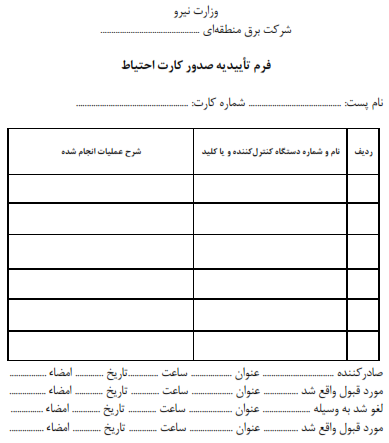
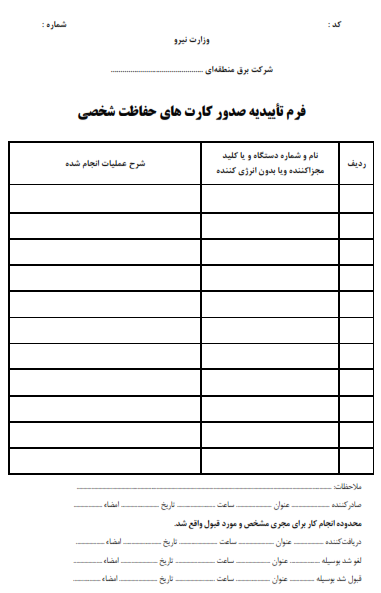
For work on a single device, circuit or bay, the "personal protection card issuance confirmation" form shall be completed and issued in two copies, in the name of the card holder (work executor).
No one is permitted, under any circumstances, to enter the work executor's work area without their consent.
Under no circumstances is anyone permitted to carry out operations on the isolation and de-energization guarantee points.
Under no circumstances is anyone permitted to cancel an issued personal protection card; only the card holder is permitted to cancel their own card.
All guarantee points relating to isolation and de-energization shall be fitted with a lock or safety latch, such that no one is able to carry out operations on them.
For isolation and de-energization guarantee points, switches with visible contacts shall be used, so that their open or closed state can be determined by looking at them. Where switches with hidden contacts must be used, the work executor shall, before starting work, test the device and circuit in question for the absence of voltage (using a standard voltage detector suited to the voltage level) and confirm that the switch contacts are open.
Switches used for isolation guarantee points shall be placed in the open position and locked, or part of the switch's closing mechanism or part of the switch's control circuit shall be removed or disconnected, so as to prevent them from being closed unintentionally as a result of an inadvertent operation.
Where the device is not capable of being locked, the issuer shall provide the requester with all the necessary warnings and information regarding the hazards of the work area, for the purpose of preventing potential incidents, and shall record this in the "Remarks" section of the card.
The work executor shall supervise the work of the crews under their charge until work is complete, and shall not, for any reason, leave the work area; where they wish to leave the work site for any reason, they shall stop work entirely.
Where the duration of the work is long (more than one day), the work executor shall, each day after stopping work and moving personnel away from the area, hand over the personal protection card confirmation form to the issuer and declare that work has stopped for the day and that personnel have left the site; on the following day, before starting work, they shall first obtain the personal protection confirmation form from the issuer, and shall not be permitted to work until it has been obtained.
For work on circuits whose voltage exceeds 400 volts, the work executor shall install temporary earthing before starting work.
For work on circuits whose voltage is less than 400 volts, the work executor shall, before starting work, carefully test the circuit, confirm that it is de-energized, and short-circuit it.
Where the work executor is forced to leave the work site (owing to an accident, illness or similar), they shall cancel their personal protection card, and the necessary steps shall be taken to issue another card in the name of another authorised person.
Where, for any reason, the work executor fails to attend work (owing to illness, an accident or similar), work shall first be stopped, and the work executor's supervisor, together with the issuer (operator on duty), shall declare their agreement in writing to cancel their personal protection card; this cancelled card shall be permanently archived in a dedicated file.
The issuer shall keep all keys, safety latches and disabled mechanisms in a secure location, out of reach of others, and shall not hand them to anyone until work is declared complete and the personal protection card and the personal protection card issuance confirmation form have been cancelled.
The de-energization operation shall be carried out after the isolation operation is complete; at the request of the work executor, the pressure of gases and liquids shall be discharged down to atmospheric pressure and hazardous gases shall be fully discharged, the necessary precautions shall be taken for hazardous liquids and gases, and hot devices shall be cooled to an acceptable level in accordance with the manufacturer's instructions.
To test that the isolation guarantee points of a device or circuit are de-energized, sound and suitable safety equipment, matched to the voltage, shall be used.
Cancelled personal protection cards, together with the confirmation, shall be archived for one year and, where an incident has occurred during the work, shall be archived permanently in the safety unit's incident file.
Since blocking devices are used to carry out the isolation operation from mechanical sources, a further careful inspection of them shall be carried out to ensure that they are fully closed, and, where necessary, they shall also be tested.
Once it has been confirmed that the blocking devices used to carry out the mechanical isolation operation are open and fully discharged, their operating shaft shall be locked by means of locks or safety latches or other suitable protective devices, to prevent them from closing unintentionally by mechanical means. Where blocking devices are fitted with electrical means for opening and closing, their electrical control circuit shall be disconnected, to also prevent them from opening or closing unintentionally by electrical means.
Since blocking devices are used to carry out the de-energization operation from mechanical sources, a further careful inspection of them shall be carried out to ensure that they are fully open, and, where necessary, they shall also be tested to confirm that hazardous conditions have been eliminated.
Duties of the Personal Protection Card Holder (Work Executor)
The personal protection card holder (work executor) shall, before starting work, carry out the following: (a) Attend the issuer (operator) and, having described the type and location of the work, the start time and the approximate duration of the work, request the issuance of a personal protection card. (This request is made verbally and in person.) (b) Before the personal protection card confirmation form is issued, work is not permitted under any circumstances; the work executor may only make the preparations and gather the equipment required for the work, outside the work area, under fully safe conditions.
Duties of the Personal Protection Card Issuer
After receiving a request for a personal protection card, the issuer (operator) shall, to review, approve and issue the personal protection card, carry out the following steps in sequence: (a) Inspect the work location together with the personal protection card holder (work executor) and, where there is no problem or point of ambiguity, agree to issue the personal protection card, in coordination with the operations official. (b) Carry out the isolation and de-energization operation, with the fitting of locks or safety latches, in the presence of the work executor, and have the work executor confirm that the safety-making operation has been carried out. (c) Where necessary, install barriers and warning safety signs at the required locations, in the presence of the personal protection card holder (work executor). (d) The issuer (operator) shall complete the personal protection card issuance confirmation form in two copies and, after it is signed by the card holder (work executor), hand over the first copy to them and inform them that they may begin work. (e) Record the number of the personal protection card issuance confirmation form, as well as the numbers of the personal protection cards, the location and type of work, and the name of the holder, together with the time and date of issue, in the log for issuing personal protection cards.
Regulations for Cancellation and Voiding of the Personal Protection Card
Once work is complete, to cancel an issued personal protection card, the personal protection card holder shall carry out the following: (a) Remove work tools and equipment from the work area, remove the installed temporary earthing, clean the work area with due regard to environmental considerations, and remove materials and items from the work area. (b) Restore the work area and device to their original condition, move all personnel under their charge away from the work area, and inform them that work is complete and that no protection remains in place; accordingly, no one is permitted to enter the work area whose work has ended, and the device or circuit shall be regarded as energized. (c) Attend the issuer (operator), describe the work carried out, and report the latest condition of the device or circuit, the completion of the work and the removal of the installed temporary earthing, and request the cancellation of the personal protection card issuance confirmation form and their personal protection cards, and state that the device may be returned to service without obstruction, or that it cannot be returned to service owing to a technical fault.
Upon a request from the work executor to cancel the personal protection card, the issuer (operator) shall inspect the work area and, provided there is no point of ambiguity, carry out the following to complete the cancellation: (a) Obtain the first copy of the personal protection card issuance confirmation form held by the work executor and, after completing the relevant row, proceed to cancel it. (b) Remove the installed personal protection cards. (c) Collect any barriers and warning safety signs that have been installed. (d) Where necessary, carry out the operation to restore the de-energized guarantee points to their original condition. (e) Where necessary, carry out the operation to restore the isolation guarantee points to their original condition. (f) Once the operation is complete and the guarantee points have been restored to their original condition and the device is ready for service, carry out a final inspection to confirm the device's condition and the correctness of the operations carried out and, in the presence of the work executor, place the device back into the circuit, and together with them carry out a final inspection of the device or circuit. (g) Record the operational status of the device or circuit in the daily report log and the log for issuing personal protection cards.
Device Protection Card
The request to install or cancel a device protection card shall be made by the operations official or the dispatching operator.
Where the requester (the operations official or the dispatching operator) is located at a distance, the operator shall complete the "Requester" row and sign it on their behalf.
Regulations for Cancelling the Device Protection Card
Where the operator is unable to reach the requester for cancellation of the card, they may, in coordination with dispatching, following a request made through communication devices and after recording the time and date on the card, sign the card on the requester's behalf.
Guarantee Certificate Forms
For work on devices, circuits, lines and equipment whose voltage exceeds 1000 volts, and whose isolation and de-energization guarantee points (whether electrical or mechanical) are located at a single station or at stations connected by the line and circuit, guarantee certificate forms are issued according to the conditions, type and location of the work.
Station Guarantee Certificate Form
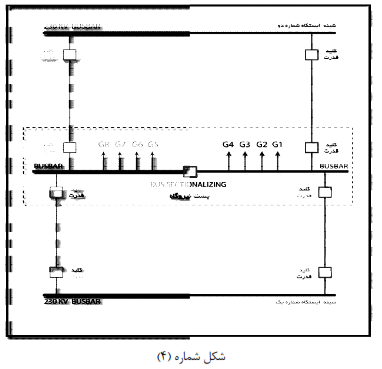
The following conditions shall be fully complied with for the station guarantee certificate form: (a) Where the requester intends to carry out operations on line-head equipment or along the length of a line, the guarantee certificate requested shall be a station guarantee certificate, and the issuer shall proceed to issue the guarantee certificate form. (b) The task of coordinating the issuance of the station guarantee certificate at the related stations rests with the regional dispatching center; once the guarantee certificate has been issued at the stations connected to the requested line, all rows of Table A of the guarantee certificate issued at the originating station shall be completed by the station operator on duty, in coordination with dispatching. (c) The station guarantee certificate at the related stations shall be issued in the name of the work executor, at the request of the operator at the originating substation and in coordination with dispatching. (d) To issue the guarantee certificate at the request of the originating operator, the operator at the opposite station shall, after coordinating with and obtaining the agreement of the relevant dispatching center, proceed to issue the guarantee certificate in the name of the work executor, and, after carrying out the switching operation stages and installing the prohibited operations card appropriate to the form, complete the issued guarantee certificate form and sign it on the work executor's behalf. The originating station's operator shall also record the details of the guarantee certificate issued at the opposite station in Table A of the guarantee certificate issued for the requested line. (e) Where no work is carried out on the equipment of other stations connected by the line, there is no need to complete a guarantee certificate request form to issue a guarantee certificate at those stations, and the original request issued at the originating station is sufficient.
When issuing the guarantee certificate for the opposite station, where devices or lines lack an earthing switch, the operator shall, in coordination with the work executor, correctly use suitable temporary and portable earthing.
In emergency conditions involving work on lines, where it is not possible for the work executor to attend the nearest station to obtain a station guarantee certificate, the operator, at the request of and in coordination with dispatching, shall issue a station guarantee certificate by telephone or radio, in the name of the work executor.
Note - There is no need to complete a "guarantee certificate request" form to issue the guarantee certificate in the name of the "work executor".
Regulations for Issuing and Cancelling the Request Form for Operations under the Work and Test Permit
In cases where a work and test permit form has been issued and the guarantee certificate holder (work executor) needs to carry out a test during the work, they shall carry out the following: (a) The guarantee certificate holder (work executor) shall move all personnel away from the work area, attend the form issuer, complete the request form for operations under the work and test permit in two copies, and take no action until the issuer has confirmed in writing that the conditions for testing are ready. (b) The guarantee certificate holder (work executor) shall notify each of the personnel under their charge individually about the test, provide the necessary guidance, move them away from the work area, and instruct them not to approach the work site until the end of the test is announced. (c) The guarantee certificate holder (work executor) shall notify all persons whose names are recorded in Table B attached to the work and test permit form about the test, move them away from the work area, ask them to complete the "names of supervisors and visitors informed of the testing process and return to the guaranteed condition" table, sign the test request form to confirm they are aware of the test, and instruct them not to approach the work area until the end of the test is announced. (d) The guarantee certificate holder (work executor) shall deliver the completed test request form to the guarantee certificate issuer, so that the conditions for starting the test can be prepared, and shall wait until the issuer announces that the operation may proceed. (e) The guarantee certificate holder (work executor) shall provide the necessary cooperation to the issuer in preparing the conditions for starting the test. (f) After carrying out the operation and preparing the conditions required for the test request, the guarantee certificate issuer shall complete and sign the request form for operations under the work and test permit in two copies, return the first copy to the guarantee certificate holder for their information, and place the second copy in the "work in progress" section of the work and test permit file. (g) After receiving the form confirming that the conditions for testing are ready, the guarantee certificate holder shall carry out the permitted tests recorded on the test request form. (h) Where the guarantee certificate issuer determines that carrying out the test may endanger the device's integrity or may have an adverse effect on the network and equipment, they shall not approve the test and shall seek instructions from the operations officials. (i) The guarantee certificate holder is responsible for the preservation of the device during the test, and shall exercise the necessary care during the test to prevent damage to the devices. (j) The guarantee certificate holder (work executor) shall always be ready, at the issuer's request, to prepare the device or lines for service as soon as possible and to cancel their guarantee certificate form.
After carrying out the tests, to restore the conditions to the guaranteed state set out in the work and test permit form, the guarantee certificate holder (work executor) shall attend the issuer again and carry out the following steps in sequence: (a) Cancel the request form for operations under the work and test permit. (b) Notify all persons whose names are recorded in Table B attached to the work and test permit form, individually, of the necessary steps to complete the test, and have those persons sign the "names of supervisors and visitors informed of the testing process and return to the guaranteed condition" table on the request form for operations under the work and test permit. It is also necessary to instruct them not to approach the work area until the completion of the operation and the return of conditions to the guaranteed state under the guarantee certificate form has been announced. (c) After cancelling the request form for operations under the work and test permit, the guarantee certificate holder (work executor) shall wait until the issuer notifies them that the conditions have returned to the original guaranteed state. (d) After the operation is complete and the conditions have returned to the original guaranteed state in accordance with the issued work and test permit form, the issuer shall sign the "Accepted by" row on the second copy of the request form for operations under the work and test permit, stating the date and time, and shall archive it in the "completed work" section of the relevant work and test permit file. (e) After cancelling the request form for operations under the work and test permit to confirm the return to the guaranteed state, the guarantee certificate holder shall notify the crews under their charge, as well as the persons whose names are recorded in Table B. (f) Where the work executor needs to continue work after conditions have returned to the original guaranteed state, they may resume work under the same previous work and test permit form; otherwise, once completion of work has been declared, they shall cancel the previously issued work and test permit form.
General Regulations for the Guarantee Certificate Request
The general regulations for the guarantee certificate request are as follows: (a) Only responsible, authorised persons may complete the guarantee certificate request form. (b) The guarantee certificate request form shall be completed "legibly and without crossing-out", erasure, correction fluid or similar. (c) The guarantee certificate request form shall be completed before work begins, in accordance with the standing operational instructions issued by the Ministry of Energy, and delivered to the operations officials, so that they have sufficient time to review it and plan. (d) In emergency conditions, the requester may immediately complete the guarantee certificate request form and submit it to the operator on duty. (e) Where there is a great physical distance between the requester and the operations official, the requester may submit their request to the operations official by telephone, radio, fax or other means of communication, and the operations official shall complete the request form and read it back to them once; upon confirmation, they shall record the requester's full name and sign it on their behalf. (f) After being informed that their guarantee certificate request form has been approved, the requester shall, before the time work is due to start, contact the operator on duty and ascertain the status of the guarantee certificate. (g) The requester and the work executor are not, under any circumstances and for any reason, permitted to carry out work before the guarantee certificate form is issued. (h) Where the work executor is, for any reason, unable to attend the work site or unable to carry out the work at the scheduled time, they shall notify the requester in writing as soon as possible, and the requester shall in turn notify the operations official and cancel their request form. (i) Where it becomes necessary to change any of the following on the guarantee certificate request form: the type of guarantee certificate requested, the work executor or deputy work executor, the devices or lines on which the work is to be carried out, the description of the work or the full description of the tests to be carried out, the energized devices and lines adjacent to the work site, or the start or end date of the work, the guarantee certificate request form shall be returned to the requester so that they can cancel their form and complete another one. (j) The requester shall provide the issuer with all the information required, in a proper and safe manner, for the purpose of issuing the guarantee certificate. (k) The requester, like the issuer, bears responsibility for complying with the protective regulations and shall carry out the necessary checks. (l) The requester shall deliver the completed guarantee certificate request form to the recipient (operations official) and provide the necessary explanations regarding the location, type and manner of the work and, where necessary, shall inspect the work area together with the operations official, so that no point of ambiguity remains.
Note - In emergency conditions, where the station operator is unable to reach the approver, they shall obtain the approver's agreement by telephone, radio or other means of communication and, after recording it on the guarantee certificate request form, sign it on the approver's behalf.
The final approver of the guarantee certificate request form (the operator) shall review the details recorded on the guarantee certificate request form and carry out the following: (a) Check the accuracy and completeness of the information recorded, in terms of the safety of the work area and the removal of the device or line from the circuit and, where the information is not sufficient or clear, obtain the necessary information from the requester. (b) Inspect the work area, so that no ambiguity remains. (c) Carefully review the execution of the operation and the safety of the work area. (d) Where the "energized devices and lines..." row on the guarantee certificate request form has been completed, carefully check that the energized lines or devices adjacent to the work site do not pose a hazard. (e) Where carrying out the switching-off, isolation and de-energization operation creates no issue, the adequacy of the work area's safety is guaranteed, there is no obstacle to carrying out the work, and the necessary provisions have been made for taking the device out of service, they shall communicate their agreement to the requester. (f) Where the guarantee certificate request is not agreed to, they shall record their objection in red, stating the reasons for the disagreement, and return the request form to the requester.
Regulations for Issuing the Guarantee Certificate Form
Duties of the Guarantee Certificate Issuer (Operator)
The official responsible for issuing the guarantee certificate form (the operator) shall, after receiving the completed and approved "guarantee certificate request" form, review it in the presence of, and together with, the work executor, and carry out the following stages: (a) Prepare and complete the required guarantee certificate form and the related documents. (b) Review the guarantee certificate form and the completed documents to confirm the correctness of the operations recorded, having regard to the description of the work and its location. (c) Carry out the switching-off operation. (d) Carry out the isolation operation. (e) Carry out the de-energization operation using an earthing disconnector or, on lines without an earthing disconnector, manual temporary earthing. (f) Carry out the operation to make the work area safe from energized and hazardous devices and lines adjacent to the work site, in accordance with the details recorded on the guarantee certificate request form. (g) Carry out the operation to fence off the work area. (h) Guarantee the guarantee certificate form. (i) Show the guarantee points to the requester (work executor). (j) Install the "prohibited operations" card on the guarantee points. (k) Obtain the requester's (work executor's) signature on the guarantee certificate form. (l) Issue the guarantee certificate form. (m) Provide the first copy of the guarantee certificate form to the work executor and inform them that they may begin work. (n) Attach the sequence of operations forms and Table B form to the second copy of the guarantee certificate form, and keep them in a separate file with all the documents and instructions, together with the keys to the locks and safety latches, in their own possession, out of reach of others. (o) Record the number, time, holder's name and type of the issued guarantee certificate in the daily report log and the dedicated guarantee certificate log.
Duties of the Guarantee Certificate Holder (Work Executor) in the Issuance Process
The responsibilities of the guarantee certificate holder (work executor) are as follows: (a) The guarantee certificate holder is responsible for the safety of the personnel under their charge and shall be present at the work site from the start to the end of the work and supervise them. They are not, under any circumstances or for any reason, permitted to leave their work site. (b) The guarantee certificate holder is not, for any reason or under any circumstances, permitted to carry out work before receiving the guarantee certificate form. (c) The guarantee certificate holder shall identify and describe, to the personnel under their charge, the devices on which work is permitted, together with the permitted work boundary. (d) Before starting work, the guarantee certificate holder shall first determine the number of temporary earthing connections (temporary earths) required to make the work area safe, to be installed on either side of the work site, and shall record and sign the number in the "Are temporary earthing cables installed" section of the guarantee certificate form. (e) That temporary earths shall be installed within the boundary of the permitted work area, and responsibility for determining the suitable installation location rests with the guarantee certificate holder (work executor). (f) The guarantee certificate holder (work executor) shall explain the hazards of the energized devices adjacent to the work site to the personnel under their charge. (g) The guarantee certificate holder (work executor) shall explain the isolated points, the de-energized points, and the installed temporary earthing to the personnel under their charge. (h) Where switches with hidden contacts are used at the guarantee points, the work executor shall, before starting work, test the device and circuit for the absence of voltage (using a standard voltage detector suited to the voltage level) and confirm that the switch contacts are open. (i) For work on circuits whose voltage is less than 400 volts, the work executor shall, before starting work, carefully test the circuit, confirm that it is de-energized, and short-circuit it. (j) The guarantee certificate holder (work executor) is responsible for the safety of persons to whom they grant entry to their work area for a visit or inspection (names recorded in attached Table B) and, where they are unable to ensure their safety, shall refuse to grant them entry. (k) Where the guarantee certificate holder (work executor) wishes, for any reason, to leave the work area for a short period, they shall first stop work and move personnel away from the work area, and shall hand over the first copy of the guarantee certificate to the issuer (operator), so that the issuer is informed of the status of the work. (l) Where guarantee certificate forms have been issued for work lasting more than one day, the guarantee certificate holder shall, each day after work ends and personnel have been moved away from the area, hand over the first copy of the guarantee certificate form to the issuer and declare that "work has stopped for today and personnel have left the work area"; on the following day, before starting work, they shall first obtain the first copy of their guarantee certificate form from the issuer. This procedure ensures that the issuer has full knowledge of the status of the work and records the above in the report log. (m) Where the work executor is, for any reason, unable to attend to carry out the work, the issuer (operator) shall proceed to issue the guarantee certificate in the name of the deputy work executor. (n) Where the guarantee certificate holder is unable to attend the issuer owing to distance, they shall, in accordance with item (l), report the withdrawal of personnel and the stopping of work to the dispatching operator by telephone, radio or other means of communication, so that this may be conveyed to the issuer, who shall record it in the daily report log. On the following day, before starting work, the guarantee certificate holder shall first notify the issuer through the dispatching operator, so that the issuer has full knowledge of the status of the work in question. (o) The guarantee certificate holder (work executor) shall take part in the issuer's review of the details recorded on the guarantee certificate.
Regulations for Cancelling the Guarantee Certificate Form
Duties of the Guarantee Certificate Holder (Work Executor)
Immediately after work is complete, the guarantee certificate holder (work executor) shall carry out the following, and shall then proceed to cancel the guarantee certificate form: (a) Collect their tools and equipment and remove them from the work area. (b) Clean the work area and remove any surplus tools and materials from the work area, with due regard to environmental considerations. (c) Move all the personnel under their charge away from the work area and instruct them to keep a safe distance, since they intend to cancel the guarantee certificate; from this moment, no guarantee remains in place, and the devices and lines shall be regarded as energized. (d) Inform the persons whose names are recorded in Table B attached to the guarantee certificate that they intend to cancel the guarantee certificate, that those persons shall move away from the work area, and that their names shall be removed from Table B attached to the guarantee certificate. (e) Inspect the work area and the device to confirm that its condition is normal. (f) Collect the temporary earthing installed by the operator, together with the operator. (g) Attend the guarantee certificate issuer and provide a brief description of the work carried out or the changes made to the condition of the device or lines. (h) Declare to the issuer that the work tools and equipment have been removed from the work area, that the personnel under their charge have moved away from the work area, that the work area has been returned to normal, and that the temporary earthing has also been removed; accordingly, they shall request that, once all persons whose names are recorded in the attached Table B have left, guarantee certificate number ..., issued in their name, be cancelled.
Duties of the Guarantee Certificate Issuer (Operator)
After the guarantee certificate holder (work executor) declares that work is complete, the guarantee certificate issuer (operator) shall carry out the following: (a) Carry out a careful inspection of the work area to confirm that the installed temporary earthing has been removed, that personnel have moved away, that the work area is normal, that cleaning has been carried out, and that tools and equipment have been removed. (b) Collect the work-area fencing equipment and prepare the conditions for returning the equipment to service. (c) Check Table B attached to the guarantee certificate, to confirm that all persons whose names are recorded in it have been removed from the table and have signed it. (d) Confirm that the "temporary earthing cables have been removed" row on the guarantee certificate form has been completed and signed by the guarantee certificate holder. (e) The issuer shall accept the request to cancel the guarantee certificate, and the guarantee certificate holder shall sign the "Cancelled by..." row, recording their full name. (f) Where no other guarantee certificate is recorded in Table A of the guarantee certificate form, the issuer shall sign the "Accepted by..." section on the guarantee certificate form, stating the time and date. (g) Having regard to the details recorded in the "Operational Remarks" section of the second copy by the guarantee certificate holder, the issuer of the guarantee certificate form shall, in coordination with the dispatching operator and having declared work complete, proceed to prepare the device or line for service by fully carrying out the operational programmes recorded on the return sequence-of-operations form. (h) When the device or lines are ready for service, the issuer shall sign the "Device made ready for service by" row, stating their full name, and the time and date. (i) Where other issued guarantee certificates are recorded in Table A of the issued guarantee certificate form, the guarantee certificate issuer is not permitted to complete the "Accepted" row on the form, and the operation may not proceed as a result; instead, only the holder shall sign the "Cancelled by..." row, stating the time and date. (j) After completing the "cancelled guarantee certificate form", the issuer shall archive it together with the issued sequence of operations form and all attached documents; where an incident has occurred, the relevant guarantee certificate form shall be archived permanently in the company safety unit's incident file. (k) Once the operation has been fully carried out, the issuer shall return the keys to the safety locks or latches to their original location. (l) Where the work site is remote and the issuer is unable to inspect it owing to the distance, they may rely on the details recorded by the guarantee certificate holder and proceed to cancel the guarantee certificate form (such as for work carried out on lines at remote distances).
General Regulations for Guarantee Certificate Forms
The issuance of guarantee certificate forms is conditional upon the requester of the guarantee certificate (work executor) accepting its conditions.
Guarantee certificate forms are valid from the time of issue until cancellation, and during this period no one is permitted to carry out start-up operations or to energize the location in respect of which the guarantee certificate was issued.
No one is, for any reason or under any circumstances, permitted to carry out operations on the isolation and de-energization guarantee points, and no one may make any changes to them.
Note - Articles 60 and 61 do not apply to the sections specified on the request form for operations under the work and test permit.
Guarantee certificate forms are valid only for the fully specified work referred to as "permitted work", and for the specific device or line referred to as the "device or line on which work has been permitted"; and, in the case of the work and test permit, they are valid for the "permitted test" whose type and manner are precisely recorded on the form. The guarantee certificate holder is not permitted to carry out any work other than what is recorded on the form.
Guarantee certificates issued at different points of a station that have no shared guarantee points shall be drawn up so as to be fully independent, with no interdependence between them. Where several guarantee certificates need to be issued for different pieces of work carried out on several devices or different circuits within a single bay, or on lines, for different crews, the issued guarantee certificates shall be complete in terms of providing the protection relating to the permitted work recorded on them, such that cancelling one of them does not affect the continued safety of the work area.
Where issued guarantee certificates share common isolation and de-energization guarantee points, the issuer shall record the guarantee certificate number, the time and date the form was issued, and the name of its holder, in Table A.
Only one work permit form (guarantee certificate form, personal protection card, or request and permit for work without guarantee) may be issued at any one time for a single device, bay or line.
Where a work permit form or a station guarantee certificate has been issued, a work and test permit form that shares an isolation or de-energization point with these guarantee certificates may be issued only where no test that would affect the shared points has been requested.
Guarantee certificate forms guarantee the safety only of the persons working under the supervision of the holder, and of the persons whose names are recorded in Table B attached to the guarantee certificate for the purpose of carrying out an inspection or visit.
Entry by persons for the purpose of visiting or inspecting locations for which a guarantee certificate form has been issued requires the approval of the guarantee certificate holder and the agreement of its issuer; the issuer shall, upon approval, record their names in Table B attached to the guarantee certificate.
After the guarantee certificate form is issued, the issuer shall attach the Table B sheet to the copy in their possession, so that the names of visitors and inspectors can be recorded on it.
Where the guarantee certificate holder is, for any reason, unable to attend the work area, they shall first stop work, remove the work equipment from the area, and proceed to cancel their guarantee certificate.
Guarantee certificate forms shall be prepared without crossing-out, erasure, alteration or correction fluid.
The use of "ditto" is not permitted when completing guarantee certificate forms.
Before starting work, the guarantee certificate holder shall inform the personnel under their charge of the following: (a) A description of the device on which work has been permitted. (b) The type of permitted work to be carried out. (c) The boundaries of the safe work area. (d) A description of the guarantee points. (e) The location of the installed temporary earthing.
The guarantee certificate holder bears responsibility for any hazard affecting other persons, and shall carry out the work under safe, hazard-free conditions.
Persons wishing to enter an area for which a guarantee certificate has been issued, for the purpose of a visit or inspection, shall carry out the following: (a) Attend the guarantee certificate holder together with the guarantee certificate issuer and obtain the holder's agreement to enter. (b) Sign Table B attached to the guarantee certificate form. (c) Where a request form for operations under the work and test permit has been issued, sign Table B of the test request form. (d) Once the visit or inspection is complete, the visitor shall attend the issuer and sign Table B, which certifies their departure from the work area.
To cancel the issued guarantee certificate form, the work executor shall sign the second copy held by the issuer.
Where the "time and date of cancellation" row on the guarantee certificate form has not been completed, the issuer is not permitted to cancel the issued form.
Where it is necessary, to protect the work area, to also obtain a guarantee certificate form from another location, the issuer shall carry out the following: (a) Record the guarantee certificate number, the name of the issuing station, the time and date of issue, and the time the installed earthing was connected, in Table A of the first issued guarantee certificate form in their possession. (b) Where the "time and date of cancellation" row has not been completed and the installed earthing has not been removed, the issuer is not permitted to cancel the issued guarantee certificate form.
Use of the Prohibited Operations Card
For each issued guarantee certificate form, the issuer (operator) shall install a prohibited operations card appropriate to the form, bearing a specific number, on the guarantee points; the card number shall be recorded in the "card number" row of the issued guarantee certificate form.
Sequence of Operations Form
The regulations for the sequence of operations form are as follows: (a) The sequence of operations form shall be completed by the operator and attached at the same time as the guarantee certificate form is issued. (b) All the switching operations recorded shall be reviewed, having regard to the type of work to be carried out, and, where any ambiguity or inconsistency with the correct execution of the operation is found, the form shall be voided and another form completed. (c) The form shall be completed in two parts: outward (taking out of the circuit) and return (bringing back into the circuit). (d) All the operations described on the sequence of operations form shall be carried out in the presence of, and together with, the work executor.
Request and Permit for Work without Guarantee Form
Responsibility for the proper performance of the work and for compliance with safety requirements by the personnel under the work executor's supervision, and for briefing them on the hazards of the work area, rests entirely with the work executor.
The request and permit for work without guarantee form is used in the following cases: (a) Work on energized equipment and circuits, such as control and protection circuits, electrical facilities, climbing inspections of lines, live-line (hot-line) work, transformer oil sampling and the like. (b) Work on circuits and equipment for which fully guaranteed conditions cannot be created, such as work carried out simultaneously on line-head equipment (line-head and earthing disconnectors, voltage transformers and the like) at the originating station and the opposite station connected by the line, work on cable heads or busbars of medium-voltage feeders lacking a disconnector to isolate the guarantee point, or a line for which it is not possible to fully obtain a guarantee certificate from the opposite or connected station to make the work area fully safe. (c) Work on circuits and equipment that do not require guarantee points, such as point-to-point tests, busbar protection (B.B.P.) tests, circuit breaker failure (C.B.F.) tests and the like. (d) Work on circuits and equipment that cannot be kept switched off. (e) For general work in energized areas, including construction work, mechanical installations and the like. (f) Determining the time window for a work request shall be carried out in coordination with the relevant operations officials and dispatching. (g) In addition to completing the request form for coordination without guarantee, the work executor may, where necessary, also request the issuance of a caution card.
Note - Where work is carried out simultaneously at opposite stations, or at T-OFF stations connected by the line that are able to issue a station guarantee certificate for the requested line, the issuer (operator) shall, where necessary and at the request of the work executor, obtain the number of the issued guarantee certificate in coordination with the dispatching operator, and record it in the "Remarks" row of the issued request form for coordination of work without guarantee.
The employer shall identify hazards and assess the conditions of the workplace's work area, and shall implement suitable control measures to eliminate potential hazards.
The employer (whether the principal or the contractor) and all persons involved in carrying out the work shall comply with the Safety Regulation for Work on Energized Lines and Equipment approved by the Supreme Council for Technical Protection, the other regulations approved by this Council, and the other laws in force in the country.
This Regulation, comprising 2 chapters, 84 articles, 6 notes and its annexes, was drawn up pursuant to Articles 85, 86 and 91 of the Labour Code of the Islamic Republic of Iran at the session of the Supreme Council for Technical Protection held on 24/8/1395 (2016), and was approved by the Minister of Cooperatives, Labour and Social Welfare on 23/11/1395 (2017).
This Regulation replaces the Safety Regulation for Power Transmission Operations approved by the Supreme Council for Technical Protection on 23/2/1392 (2013).
Minister of Cooperatives, Labour and Social Welfare - Ali Rabiei
Annexes Section
Annexes - Forms and Samples
The annexed forms are reproduced from the Persian original. They are official blank forms and cards issued with this Regulation; their wording has not been translated. Captions below are given in English so that each sheet can be identified.